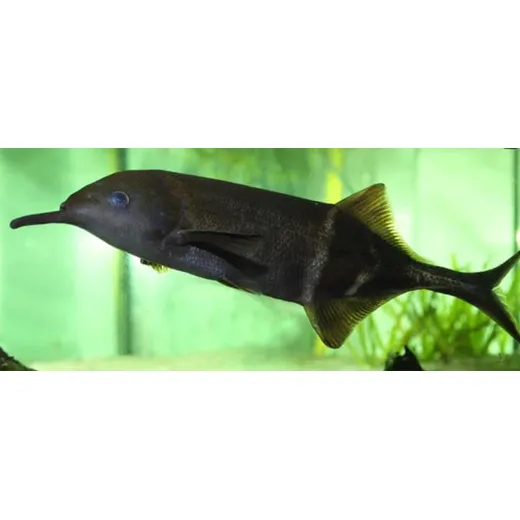
Elephant Nose Fish (3″-4″)
The Elephant Nose fish originates from the Niger River and its tributaries in Western Africa. Its body is predominantly dark with a long, tight tail and a distinctive trunk-like structure that appears to be its nose. This structure is actually an extension of the fish’s mouth and is used for sensing the environment, finding food, navigating through water, and self-defense.
The fish possesses a weak electric organ located at the base of its tail, which it uses to detect prey and navigate in low-visibility conditions.
| Feature | Detail |
|---|---|
| Origin | Niger River and tributaries, Western Africa |
| Body Color | Dark with sporadic markings |
| Distinctive Feature | Trunk-like mouth extension |
| Electroreception | Weak electric organ at caudal peduncle |
FAQ
What is the natural habitat of the Elephant Nose fish?
The Elephant Nose fish is native to the Niger River and its tributaries in Western Africa, where it thrives in slow-moving, warm, and slightly murky waters.
How does the Elephant Nose fish find food?
It uses its trunk-like structure to probe the substrate and detect food, aided by a weak electric organ at the base of its tail that helps sense nearby objects and prey.
Is the Elephant Nose fish suitable for home aquariums?
Please contact customer service


Victoria Slater –
The Elephant Nose fish is fascinating to watch. It moves slowly and uses its trunk to explore the tank, which is both unique and calming. The electric organ helps it detect food, and it’s active during the night. Great for a beginner aquarist looking for a distinctive species.
Christopher Vance –
I’ve had this fish for three months and it’s still very curious. It uses its trunk to dig into the substrate and seems to enjoy the process. The water conditions are stable, and it’s not aggressive. A bit shy at first, but now it’s more active.
Amy Morgan –
This fish stands out in any aquarium. Its behavior is unusual and entertaining. It responds to movement and uses its trunk to investigate. I appreciate the educational value of having such a unique species.