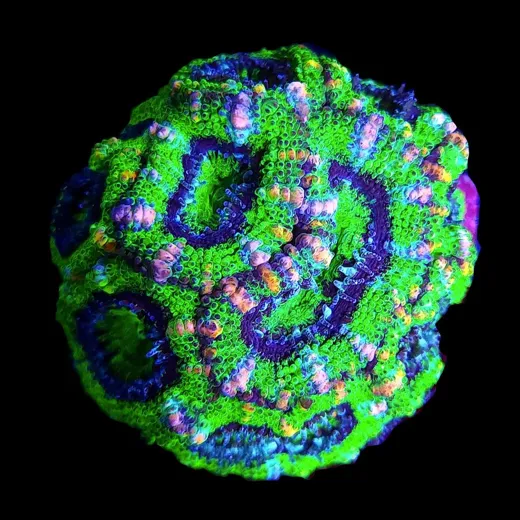
Acan Lord – Acanthastrea lordhowensis
Micromussa / Acanthastrea lordhowensis, known as the Acan Lord, is one of the most beloved and colorful LPS corals in the reef aquarium hobby. It forms dense colonies of fleshy, scalloped polyps that display stunning combinations of red, orange, teal, and metallic hues. Native to the deeper, shaded reef slopes of Australia and the Coral Triangle, M. lordhowensis thrives in stable, nutrient-rich systems and rewards aquarists with both hardiness and exceptional visual appeal.
Lighting
Low to moderate (50–120 PAR); excessive light can cause fading, while moderate blue-spectrum LEDs enhance color depth and fluorescence
Flow
Low to moderate
| Feature | Specification |
|---|---|
| Species | Acanthastrea lordhowensis |
| Colony Type | Dense, fleshy, scalloped polyps |
| Color Range | Red, orange, teal, metallic |
| Origin | Deeper reef slopes of Australia and Coral Triangle |
| Light Requirement | Low to moderate (50–120 PAR) |
| Flow Requirement | Low to moderate |
FAQ
What is the ideal lighting for Acan Lord coral?
Acan Lord thrives under low to moderate lighting (50–120 PAR). Moderate blue-spectrum LEDs are recommended to enhance color depth and fluorescence.
What flow conditions does Acan Lord prefer?
Acan Lord prefers low to moderate water flow. Strong currents may stress the coral or cause polyps to retract.
Can Acan Lord be kept in a reef tank with other corals?
Yes, Acan Lord can be kept in a reef tank with compatible corals. It benefits from stable water conditions and moderate nutrient levels.



Stewart Newman –
Installed Acan Lord in my 120-gallon reef tank. The coral has grown well with vibrant red and teal polyps. I use moderate blue LEDs and low flow. It’s one of the most visually striking corals I’ve added.
Yvonne Hodges –
The colors are impressive after a few weeks. I noticed it’s sensitive to light intensity, so I adjusted my LED setup to 100 PAR. It’s hardy and stays healthy with stable water parameters.
Diana McLean –
Grew Acan Lord in a stable system with good water flow. The polyps are active and show strong coloration. I appreciate the dense colony structure and the way it adds depth to the tank.