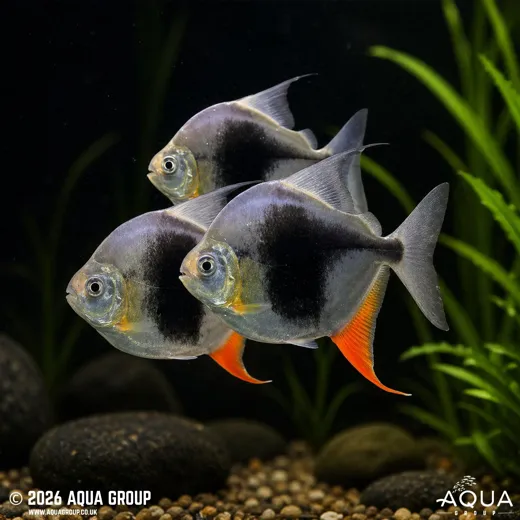
Blackberry Silver Dollar (Myloplus schomburgkii)
The Blackberry Silver Dollar is a rare and highly striking colour form of the Black Barred Silver Dollar, prized for its deep blackberry-blue to dark charcoal body tones, bold darker flank marking and rich red colouration through the fins. It is a large, fast-moving shoaling characin that makes an impressive feature fish in a spacious freshwater aquarium. Although generally peaceful, this is not a small community fish — it needs room, company of its own kind and carefully chosen tank mates.
Common Name:
Blackberry Silver Dollar. Also commonly sold as the Blackberry Myleus, Black Barred Silver Dollar, Black Belt Silver Dollar or Black-barred Myleus.
| Species | Myloplus schomburgkii |
|---|---|
| Size | Up to 10 cm (4 inches) |
| Temperament | Peaceful, shoaling |
| Water Conditions | Temperature: 22–26°C, pH: 6.0–7.5, Hardness: 3–10 dGH |
| Compatibility | Best kept with other non-aggressive, similarly sized fish; avoid small or aggressive species |
FAQ
What is the typical size of a Blackberry Silver Dollar?
The Blackberry Silver Dollar can grow up to 10 cm (4 inches) in length.
Is this fish suitable for a small aquarium?
No, this fish requires a spacious aquarium and company of its own kind. It is not suitable for small or overcrowded tanks.
What are the ideal water parameters for this species?
Ideal water conditions include a temperature between 22–26°C, pH between 6.0–7.5, and water hardness of 3–10 dGH.


Sean Hamilton –
This fish is stunning in appearance with its deep blue-black body and vibrant red fins. We have kept it in a 120-liter tank with other peaceful characins, and it’s very active and social. It does need plenty of space and company, but once set up properly, it’s a highlight of the tank.
Andrea Langdon –
The coloration is more intense than expected. We noticed it swims in tight groups and prefers to be with others of the same species. The water parameters were stable, and it has adapted well to our setup after a few weeks.
Leonard Slater –
A beautiful addition to a community tank. The fish is active and curious, and the red fins stand out well in the light. We’ve kept it with tetras and dwarf corydoras, and it coexists peacefully as long as the tank is large enough.