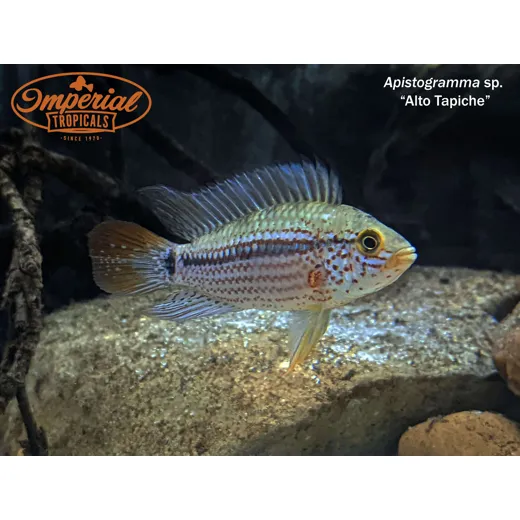
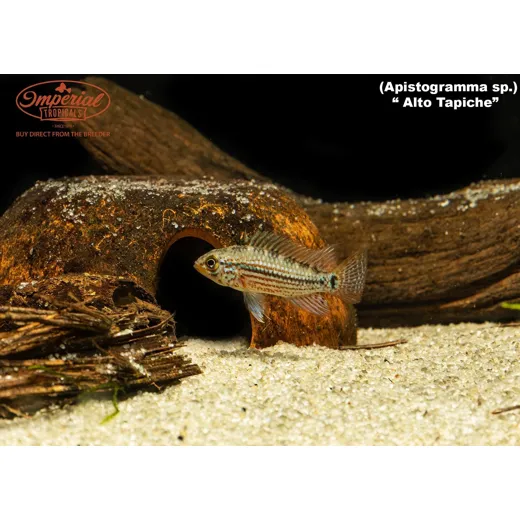
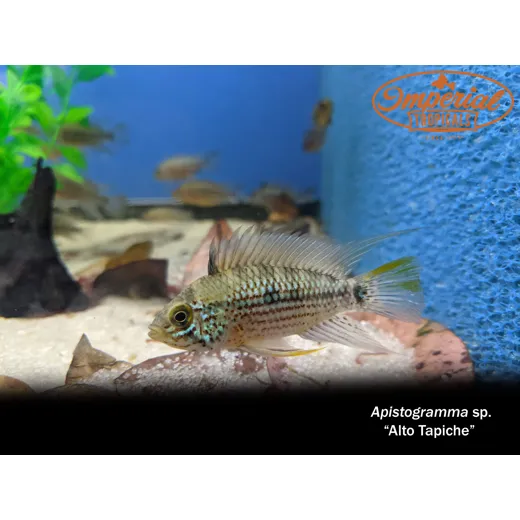
Apistogramma sp. Alto Tapiche
Apistogramma sp. Alto Tapiche are certainly one of the prettiest and most rare of dwarf cichlids. Males have stunning blue bodies with several rows of red scales forming a zig-zag on their abdomens. Bright yellow-gold fins accent an already beautiful body. These fish are from a remote region in Peru – one that takes several days to reach by boat from the main Peruvian exporters. The Rio Tapiche is primarily a white-water river, but it is stained with blackwater that enters via the Rio Blanco and other tributaries. The small streams on the outskirts of the Rio Tapiche are several inches deep, with white sand, small branches, and leaf litter as the only obstacles.
Females will turn bright yellow with black fins when in breeding dress.
| Species | Apistogramma sp. Alto Tapiche |
|---|---|
| Origin | Rio Tapiche, Peru |
| Water Type | White water with blackwater influence |
| Gender Difference | Males: blue body with red zig-zag scales; Females: yellow with black fins in breeding season |
FAQ
What is the natural habitat of Apistogramma sp. Alto Tapiche?
These fish originate from the Rio Tapiche in Peru, a remote white-water river with blackwater influence from tributaries like the Rio Blanco. Their natural environment includes shallow streams with white sand, small branches, and leaf litter.
How do males and females of this species differ in appearance?
Males have striking blue bodies with red zig-zag scales on the abdomen and bright yellow-gold fins. Females turn bright yellow with black fins when in breeding condition.
Is this species suitable for beginner aquarists?
Please contact customer service

Zoe Davies –
Received the Alto Tapiche fish in excellent condition. The male has vibrant blue body and clear red zig-zag pattern on its belly. The tank setup mimics the natural stream environment with white sand and driftwood. Very active and colorful, they seem to thrive in a well-maintained community tank.
Anthony Quinn –
The fish arrived quickly and looked healthy. The female turned yellow with black fins during the breeding cycle, which was a nice sight. I kept them in a 10-gallon tank with soft water and plenty of hiding spots. They are peaceful and add a lot of visual interest.
Andrea Clarkson –
Highly impressed by the coloration and rarity of these fish. The description matched the actual appearance. I’ve kept them for over three months and they remain active and healthy. The water parameters were stable, and they adapted well to the tank setup.