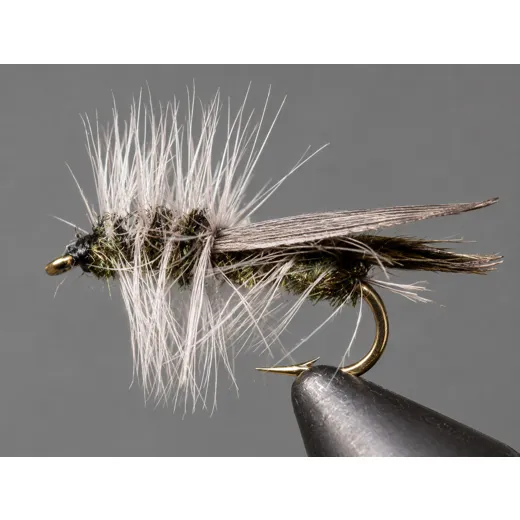
Hemingway Caddis
A realistic and highly effective dry fly pattern, the Hemingway Caddis was originally designed by Mike Lawson and named after Jack Hemingway, son of Ernest Hemingway. Known for its slim profile and natural appearance, this pattern closely imitates adult caddisflies on the water.
Built with peacock herl and a hackled underbody, the Hemingway Caddis offers subtle flash and natural movement that trout find difficult to resist. Its low-profile wing and realistic silhouette make it especially effective during active caddis hatches and selective feeding situations.
A respected Western trout pattern for decades, the Hemingway Caddis excels on rivers, spring creeks, and tailwaters where trout become selective during heavy caddis activity.
| Key Features |
|---|
| Peacock herl head |
| Hackled underbody |
| Slim profile and natural appearance |
| Effective during active caddis hatches |
| Works well in rivers, spring creeks, and tailwaters |
FAQ
What makes the Hemingway Caddis effective in caddis hatches?
Its slim profile and natural appearance closely mimic adult caddisflies, while the peacock herl and hackled underbody provide subtle flash and movement that attract trout during active hatches.
Is the Hemingway Caddis suitable for selective feeding trout?
Yes, it is especially effective in selective feeding situations due to its realistic silhouette and low-profile wing design.
Where is the Hemingway Caddis best used?
It excels on rivers, spring creeks, and tailwaters where trout become selective during heavy caddis activity.
Christopher Butler –
Used the Hemingway Caddis during a spring creek trip and caught two trout on it. The fly looks natural and moves well in the water. Great for caddis hatches when trout are selective.
Faith Butler –
This fly performs well in both active and slow feeding conditions. The peacock herl gives a subtle flash that draws trout without being flashy. A reliable pattern for Western rivers.
Diane Avery –
Felt the fly was a bit delicate in windy conditions. Still caught a few fish on it during a tailwater outing. Works well when the caddis activity is heavy.
Fiona Knox –
Highly recommended for caddis hatches. The realistic shape and movement made a big difference in my success rate. Used it on a river with strong current and it held up well.
Boris Graham –
Good quality fly with a natural look. A bit more expensive than some others, but the performance during selective feeding justifies the price.