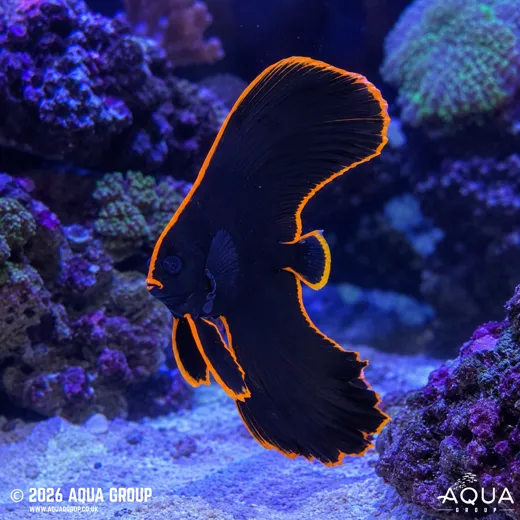
Redface Batfish
A juvenile batfish, jet black with a brilliant orange margin running the whole outline of an extraordinarily tall body. Spectacular, and among the most frequently lost fish in the marine trade.
Feeding
Feeds on sponge and encrusting invertebrates in the wild. Requires sponge-based preparations, live blackworm, mysis and clam, several times daily. Many specimens refuse food entirely and starve within weeks.
Compatibility
Peaceful but extremely timid. Not reef safe – will pick at corals and anemones. Cannot compete with boisterous tankmates.
Behaviour and personality
Drifts slowly, mimicking a toxic flatworm as a juvenile. Loses the orange margin entirely with age and becomes a large plain grey disc.
Before you buy
Please be aware before buy
| Feature | Detail |
|---|---|
| Species | Redface Batfish |
| Brand | Real Aquatics |
| Age | Juvenile |
| Color | Jet black with orange margin |
FAQ
What does the Redface Batfish eat?
The Redface Batfish feeds on sponge and encrusting invertebrates. It requires sponge-based preparations, live blackworm, mysis, and clam, fed several times daily. Many specimens refuse food and may starve if not properly fed.
Is the Redface Batfish safe for a reef tank?
No, the Redface Batfish is not reef safe. It will pick at corals and anemones and is not suitable for reef environments.
How does the behavior of the Redface Batfish change over time?
As a juvenile, it drifts slowly and mimics a toxic flatworm. With age, it loses the orange margin and becomes a large plain grey disc.

Blake Buckland –
The fish arrived healthy and looked vibrant. It’s very shy and needs frequent feeding with live foods. I had to adjust my feeding schedule and keep it in a quiet tank. It’s beautiful but not easy to maintain.
Jonathan Alsop –
It’s a stunning fish, but it refused food for two weeks. I ended up losing it. The care requirements are very high and it’s not suitable for beginners.
Anthony Kelly –
I kept it in a well-planted, low-traffic tank with no corals. It adapted slowly and now drifts calmly. Feeding it live blackworms daily is essential. It’s a unique addition to a specialized setup.
Anthony Underwood –
Didn’t survive more than a week. It didn’t eat anything and became very inactive. I’m not sure if it was stressed during transport or if the feeding was insufficient.