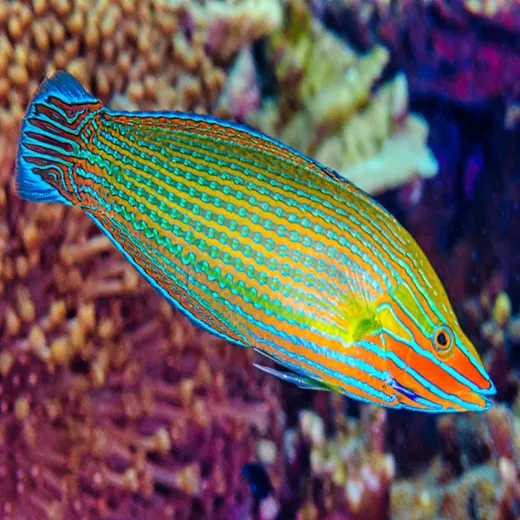
Adult Male Richmond’s Wrasse (Halichoeres richmondi)
The Richmond’s Wrasse is a hardy, pest-eating reef fish that thrives in a well-established marine tank. It requires a minimum of 70 gallons with ample swimming space and rockwork for foraging.
Key environmental needs:
- Substrate: A deep bed of fine sand (2-3+ inches) is essential for burrowing at night or when startled.
- Lid: A tight-fitting lid is required, as this species is known to jump.
Feeding: Feed meaty foods such as mysis and brine shrimp multiple times daily, along with flakes or pellets. Be aware that they may consume small crustaceans, feather dusters, and flatworms.
Compatibility: While excellent at controlling pests, they can be aggressive toward small invertebrates like shrimp and snails. Best suited for peaceful tankmates in a stable reef environment.
| Parameter | Requirement |
|---|---|
| Tank Size | Minimum 70 gallons |
| Substrate | 2-3+ inches of fine sand |
| Lid | Essential |
| Feeding | Meaty foods (mysis, brine shrimp) multiple times daily, plus flakes/pellets |
FAQ
Can Richmond’s Wrasse be kept with small shrimp or snails?
No, they are known to be aggressive toward small crustaceans and may eat shrimp or snails. They are better suited for peaceful tankmates in a reef setup.
What type of sand should I use?
A deep bed of fine sand (2-3+ inches) is required for burrowing behavior. Avoid coarse or large-grained substrates.
Is a lid necessary?
Yes, a tight-fitting lid is essential because Richmond’s Wrasse are jumpers and can escape through gaps.
Adrian Roberts –
Great pest controller in my 80-gallon tank. The fish burrows into the sand at night and eats small crustaceans without harming the main inhabitants. Only issue is it occasionally eats my feather dusters, so I now keep them in separate areas.
Steven Sanderson –
Felt like a good addition to my reef tank. It’s active and helps keep small invertebrates under control. I had to add a lid immediately after setting it up—wouldn’t have caught that otherwise.
Keith Brown –
It’s active and eats pests, but it’s a bit aggressive. I lost a few small snails after introducing it. Now I keep them in a separate corner. Still worth it for pest control.