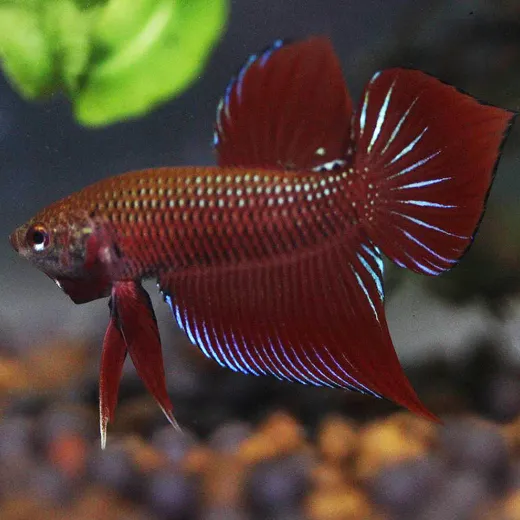
Wild Betta (Male) – Danaqua Live Fish & More
Wild bettas are less colorful, smaller, and have shorter fins than their domesticated counterparts, with duller bodies and iridescent but less prominent colors. They live in shallow freshwater habitats like rice paddies and marshes in Southeast Asia and possess a labyrinth organ to breathe air from the surface in their low-oxygen environments. Males display territorial aggression, while females are drabber and used for breeding.
Appearance
- Coloration: Wild bettas are generally subdued, with drab brown or greyish-green bodies. They have iridescent scales that can flash blue or green in the light, but these are less intense than in captive-bred fish.
- Fins: Shorter and less elaborate compared to domesticated bettas, with a more natural, streamlined shape.
| Feature | Detail |
|---|---|
| Origin | Shallow freshwater habitats in Southeast Asia (rice paddies, marshes) |
| Breathing Mechanism | Labyrinth organ allows air breathing from surface |
| Sexual Behavior | Males exhibit territorial aggression; females are less colorful and used for breeding |
FAQ
What makes wild bettas different from domesticated bettas?
Wild bettas are less colorful, smaller, and have shorter fins. Their bodies are duller with less intense iridescent colors compared to domesticated varieties. They are adapted to low-oxygen environments through a labyrinth organ that allows them to breathe air from the surface.
Are wild bettas easier to care for than domesticated ones?
Please contact customer service
Do wild bettas require special water conditions?
Yes, they thrive in shallow, warm freshwater with low oxygen levels and benefit from a surface for air breathing. A well-maintained, stable environment with moderate water temperature is recommended.


Trevor Howard –
Received a male wild betta from Danaqua. It’s smaller than expected and has a dull brown body with faint green flashes. The fish seems active and stays near the surface, which makes sense given its natural habitat. Not as flashy as store-bought bettas, but very interesting to observe in a well-maintained tank.
Joshua Parsons –
The wild betta is quite hardy and adapts well to a small tank. I noticed it breathes at the surface regularly, which confirms the labyrinth organ works. The color is subtle but natural, and it doesn’t show aggression toward other fish, which is a relief.
Ryan Wallace –
The fish is smaller and less colorful than I expected. It seems to be more active at the surface. I’m not sure if it’s fully adjusting to the tank yet. Overall, it’s a unique addition to my aquarium, though not as visually striking as domesticated bettas.